
Consumer AI
Nufeed
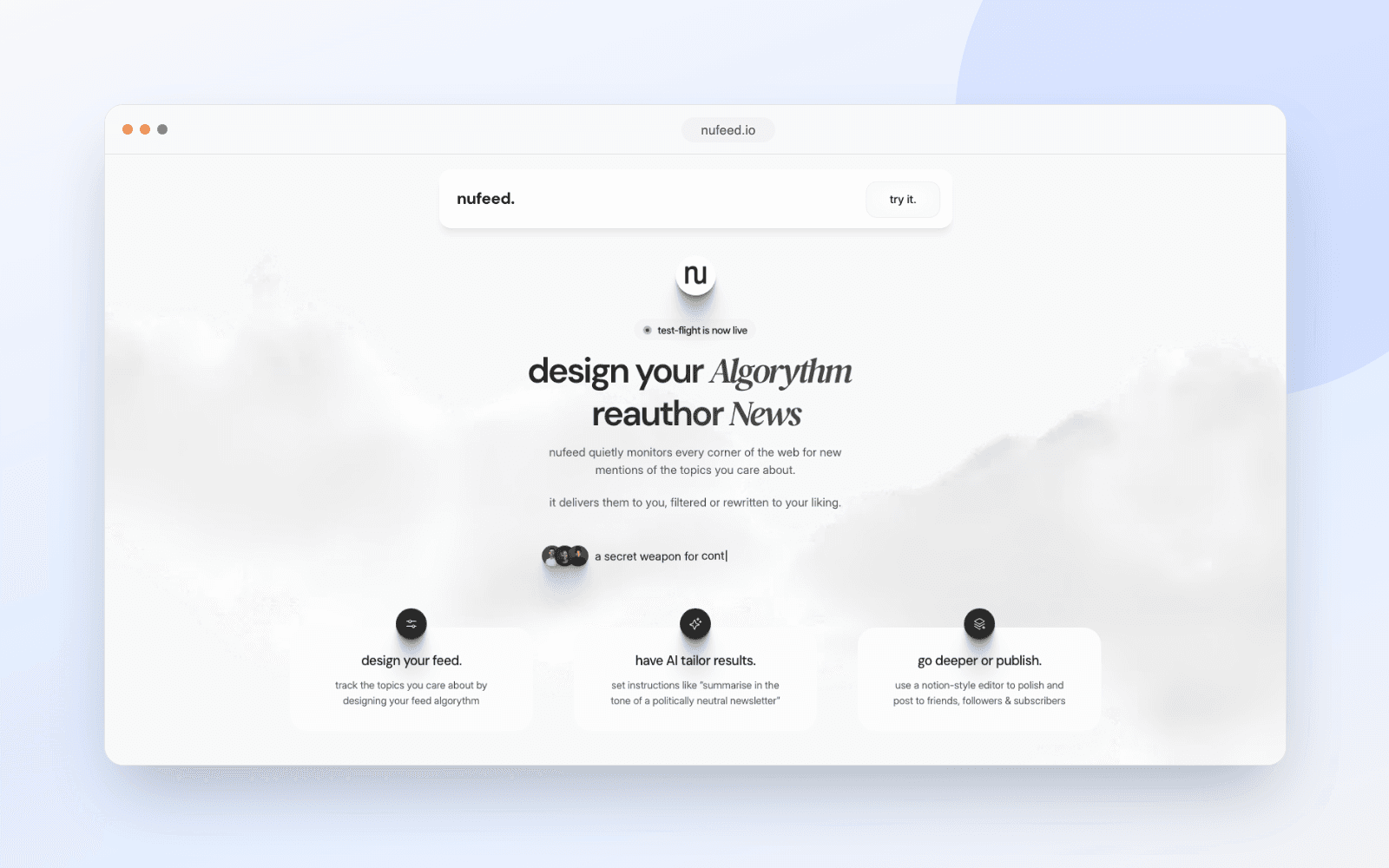
A personalised news feed that lets people design their own algorithm instead of inheriting one — taken from spec to a public test-flight in weeks.
<2s
per-topic feed rewrite latency
- Next.js
- LLM pipelines
- Content
AI in a product, not a demo. The hard part is never the first plausible output — it is knowing whether a change made things better, and keeping the feature usable when the model is slow, wrong or down. This is the work we do most of on our own systems, which is the only reason we are quick at it on yours.
If more than one of these is true, this is usually the right starting point.
Harness in the first fortnight, then the feature. One engineer, occasionally two.
The sequence this work follows, and why it is in that order.
The scoring rig is built first, against a labelled set drawn from your real queries. Without it every prompt change is an opinion, and the team argues from screenshots.
We measure the simplest thing that could work — often plain retrieval with no model in the loop. Plenty of features never need to beat it, and knowing that early saves the budget.
Retrieval, prompting and routing tuned as separate variables, each scored. Changes that do not move the number do not merge, however good the demo looked.
Latency budgets, fallbacks, and a defined behaviour when the model is slow, wrong or unavailable. The feature has to degrade into something useful rather than a spinner.
Chosen per deployment, not per fashion. If your team already runs something that works, we work in that instead.
Consumer AI
A personalised news feed that lets people design their own algorithm instead of inheriting one — taken from spec to a public test-flight in weeks.
per-topic feed rewrite latency
Most deployments draw on more than one of these.
Talk to an engineer who has done this before — and if this is the wrong place to start, they will say so.